
DONT SPLASH Splash Rules
Facts checked October 25, 2026 against live gameplay sources.
Quick answer
- Splashing = noise = the monster charges that spot. Dry movement is silent.
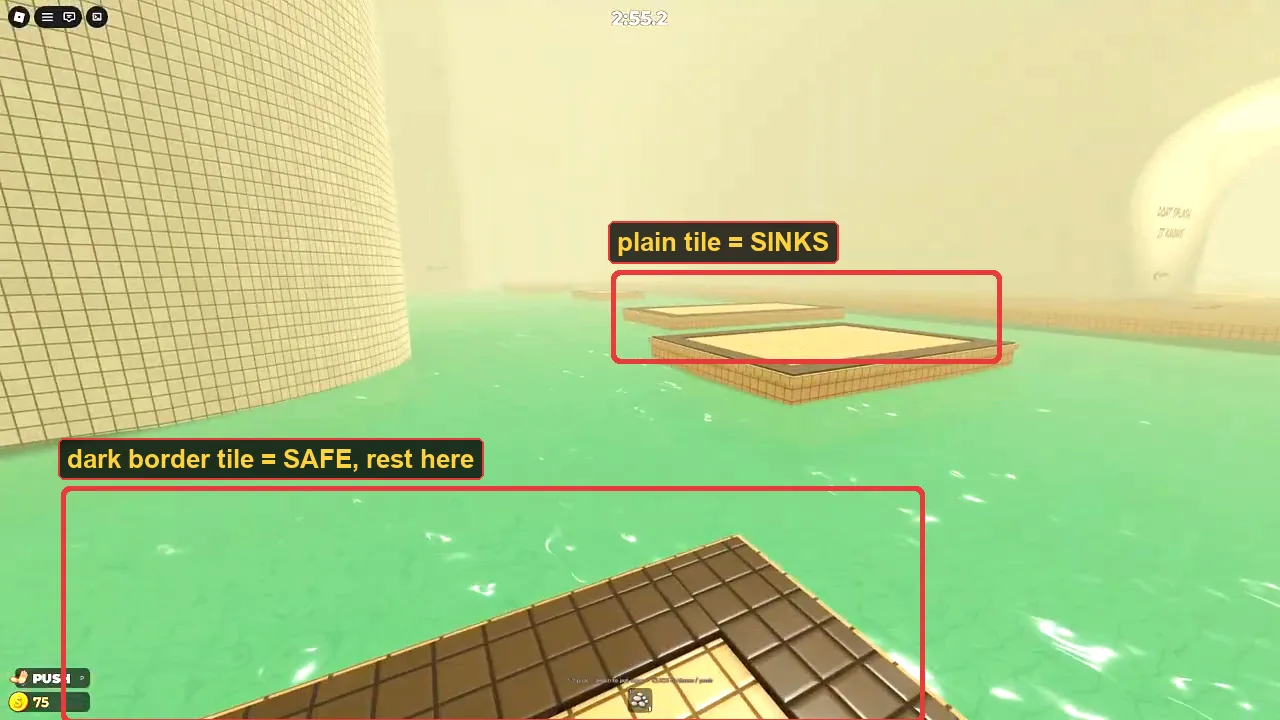
- Ordinary platforms sink a few seconds after you stand on them; dark-border tiles never sink.
- The five route rules: short gaps over long ones, wide tiles over narrow ones, dark borders as rest stops, timed rotating bridges, fast water crossings.
- The water rising after the second valve is the one phase where silence stops mattering.
What counts as a splash
The monster in DONT SPLASH hunts sound, so the whole game is a list of what makes noise. Everything that disturbs the water surface summons it to that exact spot:
- Falling in. Landing in the water downs you, slows you to a crawl and alerts the creature at once — the triple penalty.
- Clipping the surface. The water detection is unforgiving: a jump that lands on the edge of a tile can register as a splash even though you "made it." Land in the middle of tiles.
- Riding a tile down. Ordinary platforms submerge a few seconds after you stand on them. Stand too long and the tile drops below the surface with you on it.
- Throwing objects in. Pebbles and bottles splash on impact — deliberately, as decoys.
- Opening valves. The Maintenance Lock machinery is loud enough to count as a splash without any water involved.
Silent actions: walking, jumping between dry platforms, standing still, collecting pebbles, switching camera view. If it does not touch water or run a machine, it does not make noise.
The platform rule: dark borders are safe
The Sinking Platforms stage carries the game's most important written rule, right on its banner: "Platforms sink while you stand on them. Keep moving. Dark border platforms are safe."
Practical translation: light, plain tiles are one-use. The moment your feet land, a timer starts — a few seconds later the tile goes under. Dark-bordered tiles (visibly outlined corners or edges) never sink. They are your rest stops: the places where you can stop, look around, plan the next three hops, or line up a pebble throw while the monster patrols.
Recorded co-op runs capture the surprise factor perfectly — players land on a plain tile to wait for a friend and shout "they sink for real... they sink very fast" as it drops. The tile sink is faster than most new players expect. Cross light tiles one at a time: if the first landing does not sink under you, the second one still might.
The five route rules for staying dry
Reading the room before you move is half the game. These are the five selection rules, distilled from the game's own guidance and recorded runs:
- Short gaps beat long ones. When two paths exist, take the one with closer platforms even if it is slower. Long jumps are where landings fail.
- Wide tiles beat narrow ones. Broken Walkway offers exactly this choice: narrow ledges with short jumps or wide platforms with long jumps. Wide tiles forgive sloppy landings.
- Rest only on dark borders. Plan your hops so a dark-bordered tile is always your next stop when you need to pause.
- On rotating bridges, wait for alignment. Board the plank as it swings to your platform; jump off as it aligns with the next. Jumping at a closing gap is the most common way to fall there.
- Cross unavoidable water fast and far. If a crossing forces a water touch, do it while the monster is at maximum distance and keep moving through — standing in shallow water multiplies the penalty.
Teammates can splash you into trouble
In co-op, the monster is shared infrastructure. Recorded runs are full of "don't make noise!" and "why are you making noise?" — because a teammate's splash near your route sends the creature straight through your crossing path. Two habits fix most of it:
- Call your throws. A pebble decoy helps only if your teammate is not mid-jump on the route it disrupts.
- Sequence, don't parallel. The cleanest co-op runs move as a unit: one player crosses a hazard while the other watches or baits, then swap.
The one phase where silence stops mattering
After you open the second valve in the Maintenance Lock, the water starts rising and the run inverts: speed beats stealth. The exit is the only objective; take the most direct line to it, grab pebbles only if they are on the path, and treat warning panels ("platforms under in 30 seconds") as a full-sprint order. One player measured the final flood at roughly 60 seconds — a hard ceiling, not a suggestion.
Splash rules FAQ
Do landing animations splash even on a clean jump?
Only if you touch water. A clean landing on the tile surface is silent — but edge landings can register as splashes because the detection is strict about the water line. Aim for tile centers.
Does the monster splash when it swims?
Its own movement does not summon anything — it is the listener, not a noisemaker. What you hear from it is your warning of how close the "listener" is.
Is crouching or walking slowly quieter?
No stealth-slow-walk mechanic has been observed. Silence comes from staying dry, not from moving slowly — which is why the sinking-tile stages force the opposite skill: fast, precise, nonstop movement.
Keep Reading
Ready to try it yourself?
Play DONT SPLASH on Roblox