
DONT SPLASH Monster Behavior Explained
Facts checked October 25, 2026 against live gameplay sources.
Quick answer
- The monster cannot see you — the in-game wall text says it outright: "It can't see you. It hears the water."
- Three sounds call it: your splashes, thrown pebbles, and the loud valves in the Maintenance Lock.
- Distance buys time: a far splash gives you seconds to move; a close one usually ends the run.
- A thrown Flare stuns it for 5 seconds, with an 8-second immunity before it can be stunned again.
The one rule: it hears, it does not see
Every survival mechanic in DONT SPLASH follows from a single line painted on the wall of the first room: "It can't see you. It hears the water." The creature has no vision of your character. You can stand still on a dry platform directly in its path and it will pass under you without reacting. What it tracks is sound — specifically, disturbances on the water surface.
That is why the game is called DONT SPLASH. The water is not lava that hurts you directly; it is an alarm system. Touching it broadcasts your position to something that is always listening.
What calls the monster
Three categories of sound summon it to the exact spot of the noise:
- Your splash. Landing in water, clipping the surface on a bad jump, or letting a sinking tile drop you in. This is the loudest and most common call.
- Thrown objects. A pebble or bottle hitting the water makes its own splash — which is a feature, not a bug. This is the decoy system.
- Valve machinery. Opening a valve in the Maintenance Lock produces loud mechanical noise that draws it toward the cabinet. The game warns you on the banner: "The machines are loud."
Notice what is not on the list: walking, jumping between dry platforms, standing still, switching camera view. On dry tiles you are effectively invisible.
How it reacts: speed and distance
When the monster hears a sound, it rushes the source at high speed — recorded runs show players describing it as "look how fast this dude" mid- charge. Two factors decide whether a splash is survivable:
- Distance. A splash far from the creature brings it, but it takes time to arrive — you have a window to leave the area. A splash right next to it leaves you no time at all.
- Your position. It charges the splash point, not you. If you have already moved two platforms away when it arrives, it finds empty water.
Players also report being caught mid-air: if the creature is charging directly beneath your jump arc, its hitbox can grab you before your feet land. Jumping over the monster's head is not a reliable move — treat a charging monster as a no-go zone for the platforms above it.
What the creature looks like
Expect an orange-brown, pumpkin-shaped head with a dark stem, a bulky gray-brown body and thick, long arms. It patrols through the green water between platforms and columns. At close range it opens a large mouth of tightly packed teeth, and a red overlay covers your screen — that is your cue that you are about to be downed.
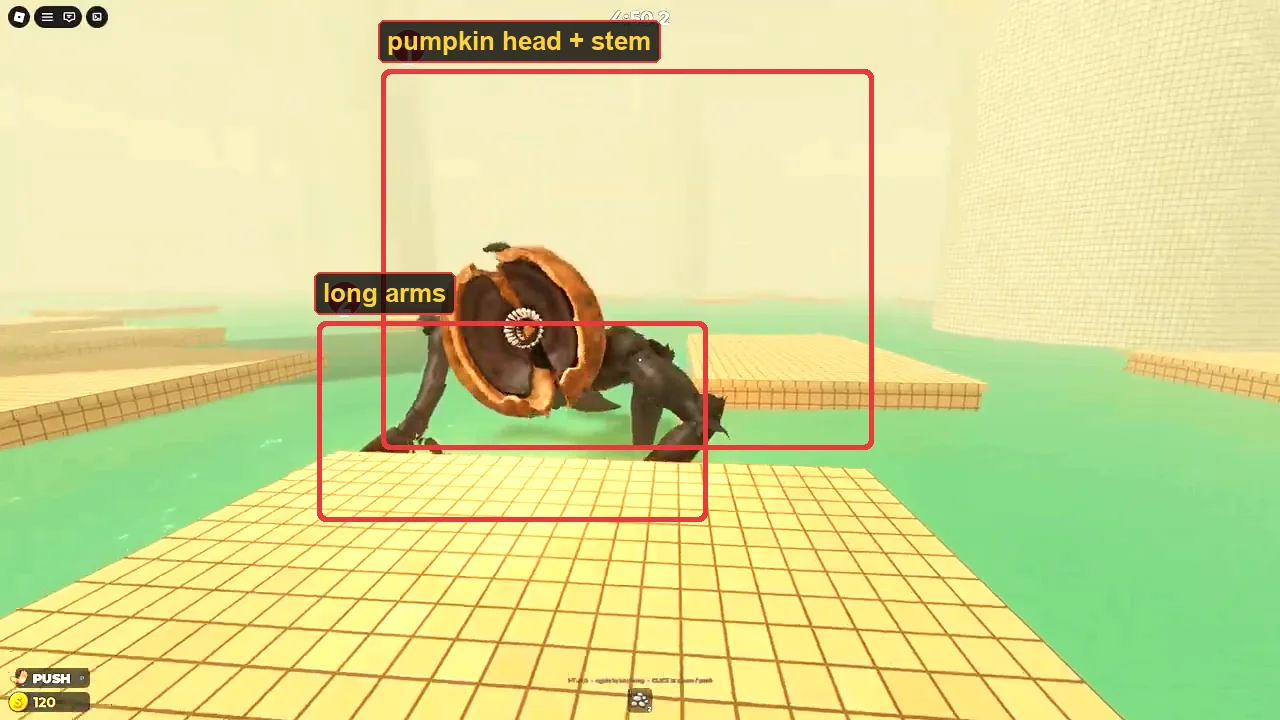
Because it patrols water, the space beside your platform matters as much as the platform ahead. Players get caught turning around: the creature can pass close along a platform edge silently, since swimming apparently does not trigger it. Track its position with the camera before every crossing.
Redirecting it: pebbles and flares
What the monster hears
"It can't see you. It hears the water." — in-game wall text
Calls the monster
- Landing in waterdowns you + slows you + calls it
- Thrown pebble / bottledecoy — this is the tool
- Opening a valvemachine noise, final room
- Tile sinking under youstanding too long
hears
only
sound
Completely silent
- Walking / jumping on dry tiles
- Standing stilleven right above it
- Collecting pebbles
- Switching camera view
You never fight the monster. You manage it. Two tools do the job:
Pebbles are the bread-and-butter decoy. Throw one into water away from your route — it skips across the surface making several small splashes, and the monster goes to investigate. The critical habit: after throwing, watch where it actually goes. Recorded runs show it moving toward a decoy, then turning back toward the player's platform. A throw is not a guarantee; it is the start of a window that you verify before using.
The Flare is the stronger tool. Hit the monster with a thrown flare and STUNNED appears — it is frozen for 5 seconds, enough to cross a dangerous section or open a valve. The same target cannot be stunned again for 8 seconds, so you cannot chain-stun your way through a room. Flares cost 450 coins to unlock at the Equipment stall — a mid-game purchase, not a first-day one.
Monster counts by difficulty
Recorded runs suggest Easy features one monster while Normal runs three. That is based on footage research rather than an official statement, so treat it as directional — but it matches the feel: Normal rooms demand far more attention splitting. Hard keeps the pressure of Normal with meaner platforming on top.
Monster behavior FAQ
Can the monster climb onto platforms?
It has not been observed climbing fully out of the water, but it reaches platform edges — recorded runs show it looming at the lip of a tile with the red damage overlay flashing. The edge zone is not safe.
Does waiting it out work?
Yes, on dry, non-sinking platforms. It investigates a sound, finds nothing, and resumes patrolling. Patience is a legitimate tool — the timer pressure comes from the sinking-tile stages and the final water rise, not from the monster.
Do teammates' splashes attract it to me?
It moves toward the sound, wherever it happened. In recorded co-op runs, players shout "don't make noise!" at each other for a reason: a teammate's splash near your crossing sends the monster straight through your route. The monster is shared; so is the discipline.
Keep Reading
Ready to try it yourself?
Play DONT SPLASH on Roblox